



Details
Early Access: This is our first MSFS scenery and has completed internal testing. It has the features described below, and we would appreciate your feedback at our Discord: https://discord.gg/x7uda6nW
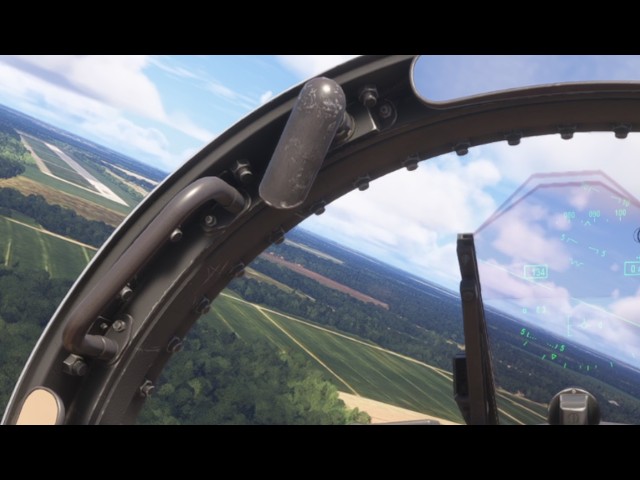
We are offering a scenery and mission bundle providing a simulation of U.S. Navy Field Carrier Landing Practice in the FA - 18E Super Hornet. It includes two upgraded U.S. Navy airfield sceneries with a mission package offering dynamic Air Traffic Control and Landing Signal Officer radio communications. Here are more details on the package components:
NAS Oceana (KNTU): During your FCLP missions you will fly out of NAS Oceana in Norfolk, VA. It is the Navy's East Coast master jet base and hosts 16 Super Hornet squadrons. Upgrades to the airport scenery include:
1. Based on the high quality of Asobo's aerial imagery of the airport, the airport surfaces have been re-worked to use that imagery.
2. New taxiway lines, paths, signage, and system labeling have been re-worked to match the actual airfield.
3. Airfield lighting has been revised to match the actual airfield.
4. Parking has been re-worked to match the actual airfield. Military-designated parking spots have been added to avoid spawning of civilian AI traffic.
5. Runway paint markings have been enhanced to match current markings at the airfield, including simulated carrier landing areas and field arresting gear markings.
6. To match the current airfield, eight functional optical landing systems have been added to all approaches.
7. Hangars and buildings have been reworked, primarily with stock Asobo objects which are a close match to the actual airfield.
Fentress Naval Auxiliary Landing Field (KNFE): You will perform your FCLP activities at a purpose-built airfield several miles away from NAS Oceana, Fentress NALF. We have applied the following upgrades to the stock MSFS scenery at Fentress:
1. Functional optical landing systems have been added to both approaches.
2. Runway markings have been added to match the actual airfield, including simulated carrier deck landing areas and landing spots for helicopters and VTOL aircraft.
3. As per the current airfield, in-deck directional lighting of the simulated carrier deck landing areas has been added. New runway and taxiway lighting has been added in a dimmed condition to match current procedures for night FCLP operations.
4. Runway materials have been revised to match the current reinforced-concrete landing areas at either end of the runway. Asobo aerial imagery is used for the taxiways and the non-runway airfield environment.
5. Custom buildings have been added for the LSO greenhouses, the on-field U.S. Navy fire station, and the TACAN station described below.
6. The unpublished, "reference-only" TACAN station has been added to the field. This station is an important component of FCLP operations. It can be tuned on channel 27X.
FCLP Mission Package: A set of six missions are included that were created using the simulator's Bush Mission functionality. The primary purpose of these missions is to provide dynamic Air Traffic Control and Landing Signal Officer radio communication during your FCLP work at Oceana and Fentress. These missions provide ATIS, clearance, tower, departure, and arrival radio communications as you are being vectored to and from Fentress NALF. These communications are triggered based on your location and altitude and include both pilot and ATC/LSO communications. These missions will spawn your aircraft at NAS Oceana's west ramp parking. Once you arrive at the Fentress carrier pattern you will be handed off to your Landing Signal Officer who will provide standard verbal corrections during your practice approaches. These six missions include a variety of weather and lighting conditions. A seventh practice mission will spawn you at Fentress NALF if you prefer to depart directly into the carrier pattern rather than being vectored from Oceana.
Tags
Notes
This product features our simInstaller technology and is available after purchase via our APP only.
Requirements
MSFS 2024 Standard or above. Because this package focuses on landing pattern work requiring frequent scanning outside the aircraft, we recommend use of virtual reality or head tracking.
Recommended Products

€ 13.95
$
USD 16.08
All sales based on Euro. Other currencies shown as reference only.£
GBP 12.17
All sales based on Euro. Other currencies shown as reference only.¥
CNY 110.90
All sales based on Euro. Other currencies shown as reference only.
€ 8.99
$
USD 10.36
All sales based on Euro. Other currencies shown as reference only.£
GBP 7.84
All sales based on Euro. Other currencies shown as reference only.¥
CNY 71.47
All sales based on Euro. Other currencies shown as reference only.
€ 11.99
$
USD 13.82
All sales based on Euro. Other currencies shown as reference only.£
GBP 10.46
All sales based on Euro. Other currencies shown as reference only.¥
CNY 95.31
All sales based on Euro. Other currencies shown as reference only.
€ 13.50
$
USD 15.56
All sales based on Euro. Other currencies shown as reference only.£
GBP 11.78
All sales based on Euro. Other currencies shown as reference only.¥
CNY 107.32
All sales based on Euro. Other currencies shown as reference only.
€ 6.50
$
USD 7.49
All sales based on Euro. Other currencies shown as reference only.£
GBP 5.67
All sales based on Euro. Other currencies shown as reference only.¥
CNY 51.67
All sales based on Euro. Other currencies shown as reference only.
€ 12.00
$
USD 13.83
All sales based on Euro. Other currencies shown as reference only.£
GBP 10.47
All sales based on Euro. Other currencies shown as reference only.¥
CNY 95.39
All sales based on Euro. Other currencies shown as reference only.
€ 8.99
$
USD 10.36
All sales based on Euro. Other currencies shown as reference only.£
GBP 7.84
All sales based on Euro. Other currencies shown as reference only.¥
CNY 71.47
All sales based on Euro. Other currencies shown as reference only.
6.99
€ 5.59
$
USD 8.06
All sales based on Euro. Other currencies shown as reference only.£
GBP 6.10
All sales based on Euro. Other currencies shown as reference only.¥
CNY 55.57
All sales based on Euro. Other currencies shown as reference only.
-20%
30-day price low:
€
6.99