




Details
Wick John O'Groats Airport (EGPC / WIC) — Caithness, Scotland
Airport History: Wick John O'Groats Airport lies about two kilometres north of Wick, serving Caithness at the north-eastern tip of mainland Scotland. Flying from the site began in 1933, when Captain E. E. Fresson's Highland Airways worked a grass field beside Hillhead Farm on mail and passenger services across the far north. The Air Ministry requisitioned the airfield in 1939 and opened RAF Wick on 15 September that year, laying hard runways and building C-type hangars. Under Coastal and Fighter Command control it became one of Scotland's most bombed airfields, with a satellite field at RAF Skitten, and more than thirty squadrons passed through, including Canadian, Polish, Australian and New Zealand units. Aircraft from Wick flew maritime reconnaissance and anti-shipping patrols over the North Sea and the Norwegian coast; among those lost was Flying Officer Sandy Gunn, shot down in 1942 and later murdered after taking part in the Great Escape. The RAF left in 1946 and the airfield passed to civil control. British European Airways operated early scheduled services, and Loganair has provided regular links since the 1970s. Highlands and Islands Airports Limited now owns and operates the airport.
Today: Today Wick John O'Groats Airport is a lifeline transport link for the far north, with subsidised public service obligation flights to Aberdeen and Glasgow. Air Charter Scotland took over the Aberdeen route in January 2026 and added Glasgow in August 2026, using a 19-seat Jetstream 32 based at Wick, with four flights a week to Aberdeen and three to Glasgow. The airport also supports the Beatrice offshore wind farm, acts as a stopover for light aircraft ferry flights between Europe and North America via Iceland, and provides an out-of-hours call-out service for air ambulance, coastguard and police flights. Far North Aviation provides handling and fuel on site. Passenger numbers were around 6,700 in 2024-25, and the airport remains central to Caithness connectivity.
Navigation Details: Runway 13/31: 1,825 m x 45 m (5,987 ft x 148 ft), grooved asphalt, lit, with 3° PAPI at both ends and displaced thresholds. The original Runway 08/26 (1,036 m) is disused. There is no ILS; approaches are RNP to both runway ends, with VOR/DME and NDB/DME procedures also available. Wick VOR (WIK) transmits on 113.60, which also carries the ATIS, and AFIS/Tower is on 119.705. Aerodrome elevation is 126 ft.
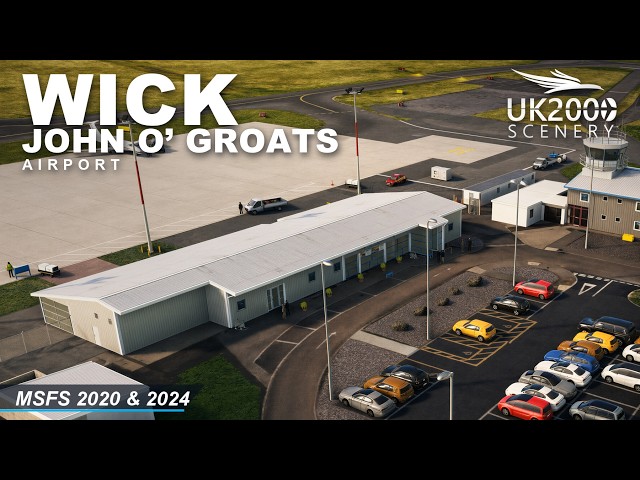
Scenery Features: This scenery is created with high-quality modelling, PBR textures and close attention to detail. It includes custom ground imagery and markings matched to the real airport. Where appropriate, while some buildings include transparent glazing and visible interiors. The scenery is optimised for efficient simulator performance and is regularly updated with content improvements and bug fixes. Airport-specific static aircraft may be included to give the airfield a distinctive, lived-in character; these do not occupy airliner parking stands, which remain available for default or add-on AI aircraft. The scenery also includes the NOSE Head switching station and the Nuclear and Caithness Archive Museum.
**You Must also install the LATEST UK2000 Scenery common Library. (from UK2000 Scenery website https://www.uk2000scenery.com/support, or MSMarketplace) ***
Tags
Notes
This product features our simInstaller technology and can be installed automatically via our APP after purchase.
Requirements
MSFS 2020 or 2024
***You Must also install the LATEST UK2000 Scenery common Library. (from UK2000 Scenery website https://www.uk2000scenery.com/support, or MSMarketplace) ***
Recommended Products

€ 7.99
$
USD 8.78
All sales based on Euro. Other currencies shown as reference only.£
GBP 6.68
All sales based on Euro. Other currencies shown as reference only.¥
CNY 58.55
All sales based on Euro. Other currencies shown as reference only.
€ 0.00
$
USD 0.00
All sales based on Euro. Other currencies shown as reference only.£
GBP 0.00
All sales based on Euro. Other currencies shown as reference only.¥
CNY 0.00
All sales based on Euro. Other currencies shown as reference only.
€ 12.89
$
USD 14.17
All sales based on Euro. Other currencies shown as reference only.£
GBP 10.77
All sales based on Euro. Other currencies shown as reference only.¥
CNY 94.46
All sales based on Euro. Other currencies shown as reference only.
9.99
€ 7.49
$
USD 10.98
All sales based on Euro. Other currencies shown as reference only.£
GBP 8.35
All sales based on Euro. Other currencies shown as reference only.¥
CNY 73.21
All sales based on Euro. Other currencies shown as reference only.
-25%
30-day price low:
€
9.99

14.99
€ 10.49
$
USD 16.48
All sales based on Euro. Other currencies shown as reference only.£
GBP 12.53
All sales based on Euro. Other currencies shown as reference only.¥
CNY 109.85
All sales based on Euro. Other currencies shown as reference only.
-30%
30-day price low:
€
14.99

€ 10.00
$
USD 10.99
All sales based on Euro. Other currencies shown as reference only.£
GBP 8.36
All sales based on Euro. Other currencies shown as reference only.¥
CNY 73.28
All sales based on Euro. Other currencies shown as reference only.
€ 39.99
$
USD 43.96
All sales based on Euro. Other currencies shown as reference only.£
GBP 33.42
All sales based on Euro. Other currencies shown as reference only.¥
CNY 293.05
All sales based on Euro. Other currencies shown as reference only.
16.99
€ 11.89
$
USD 18.68
All sales based on Euro. Other currencies shown as reference only.£
GBP 14.20
All sales based on Euro. Other currencies shown as reference only.¥
CNY 124.50
All sales based on Euro. Other currencies shown as reference only.
-30%
30-day price low:
€
16.99